


General information
Понял! Тогда все упоминания “Kirghiz” заменяем на корректное “Kyrgyz”. Ниже полностью исправленная английская версия:
History of the Kyrgyz State Technical University named after I. Razzakov (KSTU)
In the history of the Kyrgyz State Technical University named after I. Razzakov, there have been many significant events. Without exaggeration, its 60th anniversary is among the most notable.
The fate of KSTU reflects, like no other institution, the fate of the Kyrgyz Republic. Sharing all the joys and hardships with the country, the first engineering university managed to fulfill its mission during this period. It achieved the main goal: the efficiency of the higher engineering education system. Year after year, despite the profound societal and economic transformations, it successfully carried out its specific task – training highly qualified specialists in engineering-technical and engineering-economic fields, who in turn developed the entire production sector of Kyrgyzstan.
These graduates – engineers, scientists, production organizers, and entrepreneurs – built hydropower plants on the Naryn River, created unique devices and production management systems, constructed houses, factories, plants, and mines, developed transport infrastructure, and introduced original technologies in food, processing, and light industries.
Today, it is difficult to find a production company, firm, educational or research institution, or service sector where KSTU alumni are not employed. Moreover, thousands of them successfully apply their knowledge beyond Kyrgyzstan. This is a clear testimony to the demand for engineers and researchers with a KSTU diploma. Hence, the anniversary encourages a renewed assessment of the historical significance of the university, which has made a tremendous contribution to the development of the country’s economy, engineering education, technical science, and culture.
To understand the significance of KSTU, its special place in the educational and scientific space, and its contribution to the development of the country’s intellectual potential, we inevitably look back 60 years, remembering those who, under the difficult conditions of post-war devastation in the 20th century, prioritized technical education and the preparation of domestic engineering personnel. Special recognition and gratitude are owed to the initiator of the first engineering university in Kyrgyzstan, the outstanding political and state leader, and truly great son of the Kyrgyz people, Iskhak Razzakov, and his associates.
In September 1954, the Frunze Polytechnic Institute (FPI) was opened – a real breakthrough for the country’s educational sphere and, over time, for the higher education system of the Soviet Union. At that time, KSTU began with two faculties – Mining Engineering and Civil-Energy Engineering – with 350 students and 31 faculty members, among whom there were only four candidates of sciences. Just two years later, the number of faculties doubled (Civil, Energy, Mining-Geology, Mechanical-Technology). By 1959, the institute consisted of five day faculties, one evening faculty, and 31 departments.
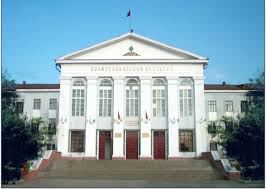
In 1962, the main building was erected on Prospekt Mira. In 1963, two general technical faculties were opened in the cities of Osh (now Osh Technological University) and Kara-Kul. In 1965, FPI faculty members received the opportunity to study in postgraduate and doctoral programs at leading technical universities of the USSR. In 1967, the multi-edition newspaper “Polytechnic” began publication.
In 1969, the first computers were introduced. New departments and specialties were established, new educational buildings constructed, and classrooms were modernized. Connections with industry were strengthened, student design bureaus (SKB) and numerous scientific clubs were organized. Students and faculty members became prize-winners in republican and all-union scientific competitions, achievements in amateur art, and record-holders in sports competitions. Importantly, from the early years, students participated in active labor for the benefit of the university and the republic: helping build academic buildings, dormitories, the “Polytechnic” recreation base on Issyk-Kul, and sports complexes. Their work benefited many subsequent generations. During summer, students joined construction brigades and provided invaluable assistance to collective farms, state farms, mines, hydropower plants, and industrial enterprises, learning the value of labor and production processes essential for every engineer.
By its 20th anniversary, FPI had become a major educational and scientific complex with modern laboratory equipment and highly qualified faculty. Training of future engineers was conducted across 12 faculties and 60 departments, educating 13,000 students in 26 specialties with 350 teachers (200 of whom held academic degrees). By that time, FPI had become a cradle for preparing highly qualified personnel for industry and construction in Kyrgyzstan and the entire Central Asian region. Among the 11,500 graduates, many became leading specialists, chief engineers, managers of trusts, directors of plants, mining administrations, research institutes, notable scientists, and state and political figures. The Frunze “polytechnic” became a true center attracting the most talented graduates of prestigious central universities. Over 20 years, FPI nurtured a new generation of faculty and teaching staff.
The first rector, Professor Georgy A. Sukhomlinov, was instrumental in these achievements. As a talented leader and organizer, he attracted a scientific and technical elite: Akmatbek S. Dzhamanbaev, Usengazy A. Asanaliev, Leonid T. Dvornikov, Rakym Usubakunov, and others. Their dedication, combined with the overflowing creative energy of FPI, laid the foundations for university technical science, established remarkable traditions, and shaped the ideals and spirit of the “polytechnic,” which continues to inspire both students and faculty.
The 1970s and 1980s, under the leadership of Vladimir M. Zhuravlev, were highly productive years for FPI, during which the university ranked among the top ten institutions in the USSR. This period coincided with economic growth in the republic and the country, with state support for education. Close contacts were established with leading technical centers such as Bauman Moscow State Technical University, Moscow Power Engineering Institute, Moscow Automobile and Road Institute, among others. International internships, academic mobility, and joint projects brought substantial economic benefits to both the university and the republic. This period also saw significant expansion of material, technical, and laboratory facilities, as well as library resources. Research achievements of FPI scientists were applied, for example, in the first lunar rover for soil sampling.
The subsequent 15-year isolation, abrupt transition to a market economy, production decline, and reduced demand for technical specialties adversely affected graduates, faculty, and the university. Intellectual migration occurred, with leading scientists and young faculty leaving the university for other fields or countries. Only the patriots of the university remained. Regional branches were briefly converted into independent universities, but this strategy was later reversed. Recently, the KSTU has regained its former branches in Kyzyl-Kiya and Kara-Kul, as well as the Institute of Mining and Mining Technologies. Despite the challenges of staff shortages, the need for faculty training, and material base modernization, the potential laid down by predecessors allowed the university to continue on its developmental trajectory.
Today, KSTU actively integrates into the global educational and scientific space:
- Establishment of the Kyrgyz-German Technical Institute in cooperation with Berlin University of Applied Sciences, offering dual Bachelor and Master degrees
- Faculty “MEI-KSTU” with Moscow Power Engineering Institute, and a Distance Learning Center with D. Serikbaev East Kazakhstan State Technical University, offering dual degrees
- Cooperation with the University of Nice Sophia-Antipolis (France) and European partners to create a structured cooperative library network
- Integration with the International Society for Engineering Pedagogy (IGIP)
- Partnerships with leading technical universities in Russia and Germany
Thanks to these collaborations, hundreds of students, undergraduates, postgraduates, and doctoral students study abroad free of charge with an obligation to return to their home university. Faculty undergo internships, enhance professional skills, establish research collaborations, defend dissertations, publish scientific results, and participate in joint research projects. Leading professors from partner universities also lecture to KSTU students.
This careful and painstaking work is already producing tangible results. Academic mobility and faculty internships enrich KSTU with modern educational technologies; computing resources are updated; grants allow the purchase of expensive modern laboratory equipment. A rapidly expanding library and information center (both traditional and electronic) now offers hundreds of valuable textbooks, technical dictionaries, and resources from partners like Bauman MSTU, Moscow State University of Printing, and the Goethe Institute.
Most importantly, returning graduates from foreign programs strengthen the country’s innovation capacity. These are modern young specialists with new knowledge, ideas, and thinking, prepared to contribute to energy, IT, and other priority sectors of the economy. They also serve as instructors, helping KSTU train specialists capable of adapting, solving problems creatively, taking responsibility, and contributing to the global labor market while conducting joint research with domestic and international partners.
The transformations in academic, scientific, international, and operational activities have also enhanced student engagement. Today, KSTU students consistently win awards at republican festivals such as “Spring Ala-Too” and repeatedly become champions of the Kyrgyz Republic Universiade.


