


History of the FLD
Department of Foreign Languages (KSTU)
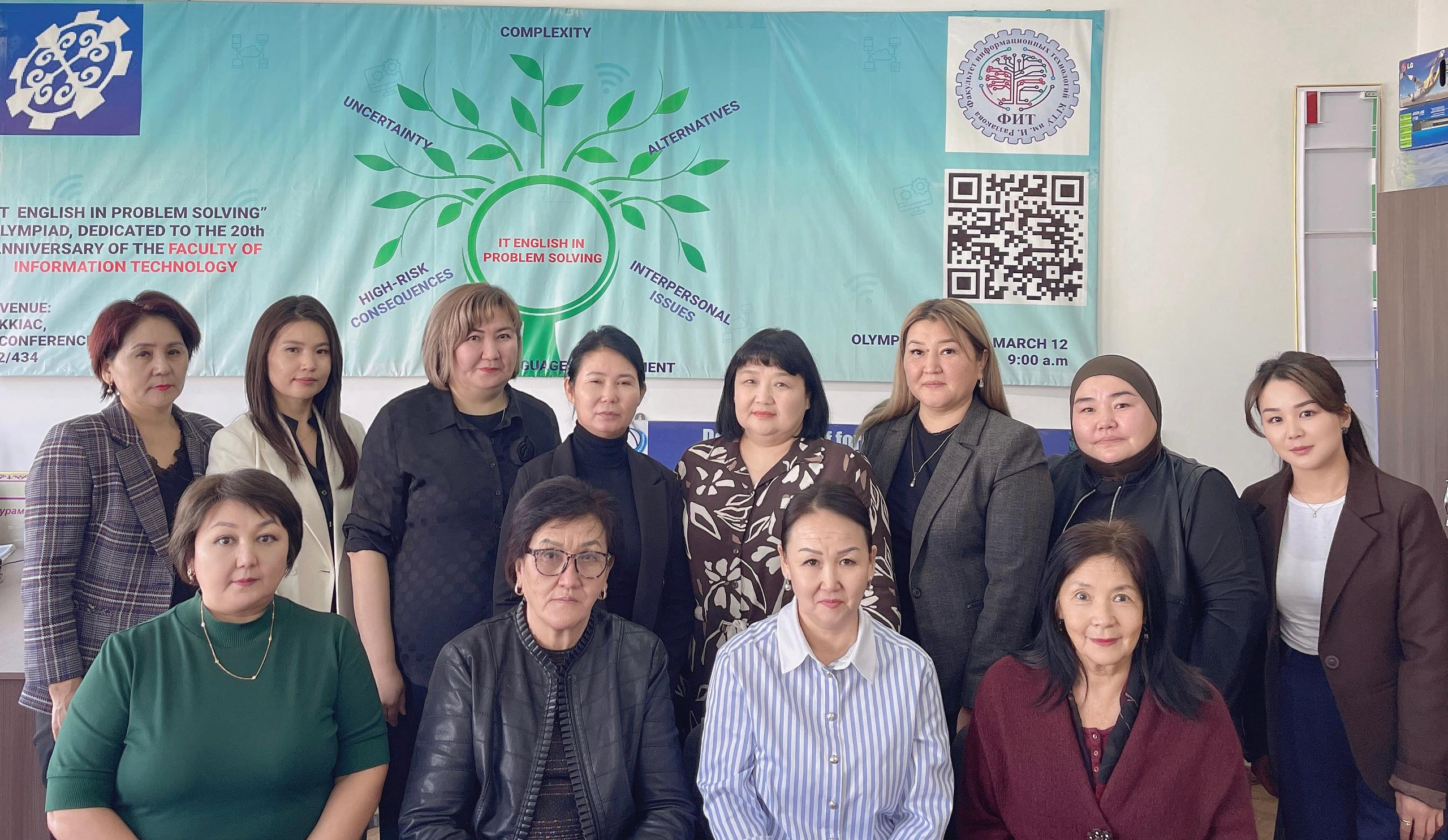
The Department of Foreign Languages was established in 1960 as a joint department of Russian and Foreign Languages, headed by Turedzhanova M.Sh. In the 1960–1961 academic years, the department was led by Neron I.B. In 1963, the department was divided into two separate departments: “Russian Language” and “Foreign Language,” the latter headed by Gromova R.K. From 1968 to 1990, the department was headed by Candidate of Philological Sciences, Associate Professor Umarov K.U. Having led the department for more than 20 years, he trained and educated more than one generation of highly qualified specialists.
In 1977, the department was divided again, resulting in the creation of the Department of Foreign Languages of the main building and the Department of Foreign Languages of the construction faculties. Scientific-methodological sections for German, English, and French languages were established within the departments. The Department of Foreign Languages attracted its students, starting from the first year, to the Student Bureau of Technical Translation, where they fulfilled orders from graduating departments and abstracted scientific and technical literature. Step by step, this work gave birth to a system and established a good tradition of organizing annual student competitions for the best translation of scientific and technical texts. Many students were distinguished by their excellent knowledge of foreign languages.
After Umarov K., the department was successively headed by Kashilov K.E., Usmanova S.S., Abdrakhmanova R.Zh., Yusupov F.I., Suyumbayeva A.A., and Chokmorova A.M. Under the leadership of Suyumbayeva A.A., the department staff began actively working on international programs and improving professional and qualification levels.
From 2010 to 2024, the department was headed by Associate Professor Chokmorova Ainura Myrzabekovna. Working actively with the department staff and university administration, and maintaining correspondence with international partners, particularly TEMPUS/ERASMUS+, in 2013 the department began participating in the TEMPUS FLEPP project (Foreign Languages for Professional Purposes). As part of this project, a Language Resource Center was established in May 2015 (room 2/622), equipped with 12 computers, 3 laptops, a document camera, a 3-in-1 printer, and modern literature. This enabled the department's instructors not only to conduct classes in English and German for university students but also to organize seminars, round tables, and conferences. Starting from 2016, English language courses were offered for both students and university faculty and staff.
Under Chokmorova A.M.'s leadership, international relations were actively developed, providing opportunities for the department staff to undergo professional development without interrupting their work. Extensive connections with partner universities in Russia and Europe require proficiency in foreign languages. Accordingly, today the department employs a different approach to foreign language teaching, taking into account the Bologna Process system.
Close cooperation with the U.S. Embassy in Kyrgyzstan opened new opportunities for the department staff and the university as a whole. Since October 2018, Fulbright scholars (native English speakers) have been invited to the department to teach free conversational English courses for students, faculty, and university staff.
Currently, the department staff continues active work on courses and research in the area of “Improving the Methodology of Teaching Foreign Languages in Non-Linguistic Universities.” Teaching and methodological work remains a priority. The department's instructors independently prepare and publish textbooks and teaching aids recommended by the Ministry of Education and Science of the Kyrgyz Republic. The specialized classrooms 2/610 and 2/622 allow the use of new teaching technologies and provide accessible materials for both in-class and extracurricular work with students.
Since September 2025, the department has been headed by Candidate of Philological Sciences, Associate Professor Shakeeva N.M. Together with the head of the department, new tasks have been set aimed at improving the quality of the educational process, activating research work, expanding international cooperation, and increasing students' motivation for language learning and creative activities.
Quality Development Strategy
STRATEGY AND DEVELOPMENT PLAN OF THE DEPARTMENT “FOREIGN LANGUAGES”
Kyrgyz State Technical University named after I. Razzakov for the Academic Years 2026–2030
Preamble:
The strategic development plan outlines the mission, goals, priority areas of development, and strategic objectives of the department across its fields of activity. It serves as a fundamental document for the development of medium-term and short-term plans, defining the key principles for decision-making in the department’s current operations.
Goal:
To establish and develop a cohesive department staff that ensures a high level of educational activity through continuous professional development of faculty and the use of modern innovative teaching technologies in the educational process, supported by advanced technical tools such as modern teaching technologies, multimedia equipment for practical classes, and up-to-date software. To ensure a high level of student proficiency in foreign languages.
In accordance with the stated goal, the following objectives are set:
Academic Activities
- Active participation of the department in professional forums, seminars, and training sessions on the content, methodology, and teaching methods of foreign languages in non-linguistic universities.
- Continuous updating and improvement of the content of educational and methodological complexes in accordance with the current State Standards of the Kyrgyz Republic.
- Systematic monitoring of teaching quality based on formal criteria, including compliance with curriculum content and appropriate forms of class organization, supported by departmental teaching and methodological materials.
- Continuous professional development of faculty through participation in training sessions, seminars, conferences (including webinars and online conferences), professional development courses, master classes, open classes, peer learning, and mentoring by experienced teachers.
- Systematic assessment of students’ educational quality through surveys and/or testing.
Educational and Methodological Activities
- Regular updating of electronic versions of teaching materials, audio, and video courses for the disciplines “Foreign Language” (Beginner, Elementary, Pre-Intermediate, Intermediate), “English Language,” “Professional English Language,” and “English in Software Engineering.” All materials should be uploaded to the portals: avn.kstu.kg and onlinekstu.kg, accessible to students of KSTU named after I. Razzakov.
- Updating and publishing textbooks and methodological guidelines using modern advanced technologies in foreign language acquisition.
- Revision of forms and methods for monitoring students’ independent (extracurricular) work.
- Updating the database of educational and methodological materials in the Kyrgyz language.
- Continuing and intensifying English language courses for the university’s teaching staff.
- Continuing active work to attract Fulbright specialists and experts in English language teaching to the educational process through the U.S. Embassy in the Kyrgyz Republic.
- Procurement of English language textbooks for levels: Beginner, Elementary, Pre-Intermediate, and Intermediate for KSTU programs.
Material and Technical Resources
- Equipping the language resource center (room 2/622) and computer classroom (room 2/610) with information technologies necessary for foreign language learning on a continuous basis.
- Expanding the availability of modern educational software for foreign language learning.
Research Activities
- Conducting research on the department’s topic:
“Improvement of foreign language teaching methodology in non-linguistic universities.” - Publishing scientific articles in national and international academic journals (RSCI, Scopus, Web of Science) and producing teaching and methodological materials.
- Active participation of the department staff in international projects; organizing conferences, seminars, training sessions, and guest lectures with the involvement of native speakers and experts in English language teaching.
- Enrollment and training of young faculty members in postgraduate and PhD programs.
- Defense of PhD dissertations.
Professional Development
Participation in international mobility programs (such as Erasmus+) plays an important role in staff training and professional development, along with advanced training in universities of the Kyrgyz Republic and abroad.
In this area, the development strategy is aimed at ensuring a high level of faculty qualification through retraining and professional development.
For young faculty members, mentoring should be strengthened, and participation in professional development courses is recommended in the following areas:
- Fundamentals of organizing the educational process for young teachers;
- Psychology and pedagogy of higher education;
- Active teaching methods in modern education;
- Information and interactive technologies.
International Cooperation
The development of international relations is aimed at integrating the department into the global academic community through the exchange of experience and the implementation of joint scientific and educational projects with foreign partners.
Continue active cooperation with the U.S. Embassy in the Kyrgyz Republic to involve native speakers and specialists in English language teaching, who make a significant contribution to the development of English language education at the university.
Note:
The strategy was discussed and approved at the department meeting (Protocol No. 5 dated January 26, 2026).


